Neel Kamal Chapagain's Thoughts and Reflections
- बेइजिंग (चीन)मा अरनिकोको श्वेत चैत्य | January 7, 2026
- जलवायु परिवर्तन सम्बन्धी थामेले गराएको ध्यानाकर्षण!!! | December 13, 2025
- Waking up to the climate change | December 13, 2025
- Declaring DoA&NA building as ‘heritage’ and implications for the Department of Archaeology | October 3, 2025
- माफ गर्नुहोला आर्किटेक्ट महोदयहरु!!! | September 27, 2025
- Sorry, Architects!!! | September 26, 2025
- भग्नावशेषलाई सम्पदाको रुपमा हेर्दा: मेरो विचारमा अबको बाटो | September 20, 2025
- भग्नावशेष, हामी, र भविष्य | September 12, 2025
Sorry, Architects!!!
- Neel Kamal Chapagain
26 September 2025
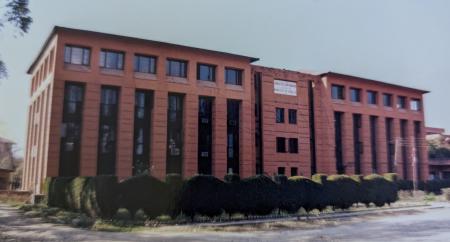
The images of destruction across Nepal (as a spinoff of the GenZ protests on 8 and 9 September) haunt us this Dashain – the festival of victory over evil. Putting these buildings on fire could neither be considered any signs of victory nor were the buildings themselves any kind of evil. As an architect and heritage thinker, I wonder what the architects of these buildings would be thinking if they were with us at the moment. All I can do at this point is to apologize to the architects of these buildings. In this blog, I am referring to Kumar Narshing Rana and Kishore Narshing Rana, as well as Louis I Kahn. There are other architects as well, but today I wish to remember these three architects – two Rana brothers and an invited American architect.
Sorry, Kumar Narshing Rana and Kishor Narshing Rana!!!
The duo Rana brothers brought the neo-classical as well as a mix of international styles to the Kathmandu valley which had until then seen palaces of relatively smaller scale and only in brick and timber. The Rana brothers were among the few privileged to go for professional studies during the Rana era. Having studied civil engineering in Britain, they designed many Rana palaces dotting the fertile Kathmandu valley. Many of these palaces later became the government property after the abolition of the Rana regime, and were adapted into government offices, colleges, libraries and so on. Though heavily influenced by the European architectural vocabularies, these palaces were desired by their respective patrons to project their images as rulers and elites of then Nepal – hence direct reflections of their status out of the autocratic regime. Yet, the infrastructure and space offered by these palaces were pleasantly adapted by the successive governments to the extent that – for example, Singha Darbar became the image of the government seat in Nepal. Having faced a mysterious fire in 1973, it lost its original glory but was rebuilt to maximum extent in the next few decades. The 2015 earthquake too damaged it significantly and the restoration had recently been accomplished. The current physical and structural condition is yet not certain (assessments are undergoing), hence a gloomy and uncertain future of an administrative complex haunts the government and public alike. There is yet no parallel to the grandeur, landscaping (garden and other amenities) as well as the building itself in Nepal. What is the outcome of this arson to an old but bold and big infrastructure – that too with so much of historical documents contained within it? We will see how the future unfolds, but all I wish to say at this point is: Sorry, Kishor and Kumar Narsingh Rana!!! Your creations deserved a better utilization but we failed.
Sorry, Louis I Kahn!!!
Much has been written about Singha Darbar, so I need not go beyond the above brief. Hence in this blog, I wish to focus on one other building that also became victim of the recent incidents. It is a building rather unheard and unnoticed (except the architects community), not so grand and in fact an incomplete building from the beginning. It is the Health Ministry building in front of the Department of Archaeology, and next to the Agricultural Development Bank. A few short coverage has surfaced about this building, particularly due to its association with a famous American architect Louis I Kahn. As my colleague architect Dilli Ram Sapkota shared some pictures after his visit as a part of a team assessing the damage, I kept thinking of this building and the faint associations that architects community in Nepal have had with this building.
My first acquaintance with this building was back in 1997 when 24 of us were studying Bachelor in Architecture in the Institute of Engineering, Pulchowk. Being the very first cohort of students of B.Arch. in Nepal, we were enthusiastic to gather our own learning materials by exploring architectural marvels that we could find around us. As a matter of fact, our first field exploration of modern buildings (other than the Malla era palaces and temples around) was the Birendra International Convention Centre – which was just about to be completed at that time. We did a study visit with members of the Chinese design and construction team which were implementing the project. Perhaps the second building we wished to visit was the one by Louis Kahn but it was beyond our reach for a study visit as it housed the Ministry of Health. However, upon learning that the government wanted to add an additional floor on it raised a concern among us about the integrity of design and building itself. A newly formed Association of Students of Architecture – of which I was the first president, took note of this development and staged a peaceful protest of the planned intervention by the government. I still vividly remember a small rally of students that we organized from Pulchowk campus, which marched from Pulchowk to Maitighar (the location of the building) and then met with the then Health Minister Mr. Bamdev Gautam to register our reservation against random intervention on an otherwise what should have been recognized as an important building. The minister – though did not agree in the beginning, consoled us that he would look into it. Not seeing any progress, Society of Nepalese Architects (SONA) followed the cause and its president then – architect Bharat Sharma sir even filed a case in the Supreme Court, and he himself participated in the court proceedings. Unfortunately, nothing worked and the ministry did whatever it wanted to do. Yet, what haunted me in the first place back then was the fact that the building was not recognized as having any significance. Well, that was and still is the fate of many great buildings we have. That led me to do a little research later on, and eventually I published a paper in VAASTU – the journal published by ASA. (I have provided below the link to get a copy of this paper if you are interested).
In that paper, I explored why Louis Kahn’s building in Kathmandu was not known whereas his other two buildings were so famous – the Parliament complex in Dhaka, Bangladesh; and the Indian Institute of Management, Ahmedabad, India. In the course of this research, I gathered some insights into the project that Louis Kahn designed for the government of Nepal. However, what was built was only a small part of a larger complex he had designed. In fact, the building itself was only half-built. There was a twin wing just behind it, but was never built. Moreover, unlike the communities in Ahmedabad and Dhaka, the incomplete building in Kathmandu was never appreciated by Nepali society at large. No wonder then that the health minister had challenged us to show him any record or writing stating that this building was of some importance. Thinking back I realized, yes he was right. This is what I attempted to discuss in my last blog where I suggested that a building could be seen as heritage only when it mattered to us, and we had somehow recorded our collective consensus on its importance. Sorry, Louis I Kahn. You deserved a much better recognition in Nepal, but your imagination did not see fruits of implementation because the government back then (King himself) was not too keen to have it all implemented.
Late than never, I am happy to notice that the Louis I Kahn designed building is now somehow recognized by the architects’ community in Nepal and are concerned about its fate today as well. However, I also wish to opine that our appreciation should be a critical one, that is to appreciate a building for what it deserves while pointing out the deficiencies and working on them as well in each cycle of conservation, renovation or reconstruction. In that line of thought, the Louis Kahn building also need to be understood as an incomplete one, and it is perhaps worth for us to understand the logic of his master planning for that area, and how we may still benefit from those unbuilt ideas. Heritage discourse should not be only about things built in the past, but also those unbuilt or to-be built and how we can build a future with due respect to the legacies of the past.
To conclude the blog today, let me briefly share what I learned about this building. The following is what I wrote in the paper that was published in 2008 (the full paper is posted here , but I quote only the relevant parts here):
….
Family Planning Central Office and Training Complex, Kathmandu, Nepal
Following the overthrow of Rana regime in the 1950s, Nepal officially opened herself to the world and was struggling to move forward embracing the ideas of development. Among other things, the issue of population control was perceived as a major challenge by the government as well as the professional groups. In such a context, family planning was promoted as a priority in the country. The first family planning service program was initiated in 1959 by a group of medical doctors under the umbrella of Nepal Medical Association. The government service in this regard began only in 1965 and was formalized with the establishment of a Family Planning and Maternal Child Health Board in 1968 (Karki, 2008). The annual report (1969/70) of the Nepal Family Planning and Maternal Child Health Project reports the progress of increased staff in the headquarters and establishment of all district level offices. The same report also mentions that “land was obtained in central Kathmandu for the new FP & MCH headquarters and early plans were made for the selection of an architect and engineering firm for its design” (Nepal Family Planning and Maternal Child Health Project, [1970]. 38 p.). No further information on the process of the selection of architect could be found. These developments were actually happening on the basis of periodical national development plans since 1960.
Coincidentally, the issue of family planning emerged as a major agenda in King Mahendra’s international diplomacy. David (1969) notes that “His Majesty (the King) was among the original twelve heads of state who signed the Declaration on Population presented to the Secretary-General of the United Nations on Human Rights Day in 1966”. The King’s initiative in the international forum, combined with the domestic need of controlling the population and the recently launched family planning programs, probably pressed the government towards institutionalizing the family planning service. David (1969) himself was an advisor to the Nepal Government on the family planning services that was to be incorporated in then forthcoming fourth development plan (1970-75). Thus, the need for an institutional infrastructure for administration and promotion of family planning practice seemed a relevant project that the government of Nepal would undertake. These developments help us understand the contexts shaping the family planning center project, however, it is not clear how the project reached to Kahn’s table.
“In 1970, His Majesty’s Government asked Kahn to design the Family Planning Center. A large triangular piece of land outside the old city walls and near the old palace is set aside to consolidate a number of public institutions. The new Family Planning Center is a part of this. Kahn recommended a plan for the entire area. Each institution would be placed in a rectangular plot on the periphery, separated by pedestrian bridges, which also connect the outer edge with the inner raised platform. Vehicular entrances are provided from below this platform. Kahn was fond of calling this place “the availability square”. The Family Planning Center occupies one of the rectangular plots. The building is made of load-bearing brick construction.” (Giurgola and Mehta, 1975, p. 172) [This is so far the only available published description about this project and this is quoted with slight rewording in Ronner et.al.1977 and 1987].
It is important to note that the above information about the site is misleading as there are no city walls in Kathmandu. It appears that the description is referring to adjacent Singh Durbar complex (a palace complex that Nepal Government acquired after abolishing the Rana regime in 1951) which now serves as the central administrative complex of the government. This clarification is important here as it helps us to understand later a probable reason why Kahn’s master plan for the given site was not pursued by the Nepal government. Further information follows: “The Central Office Building Complex was to be designed for a net floor area of 36,000 square feet. Kahn visited the site in November 1970, and proposed to position several institutions on the perimeter of the site so as to create a central plaza with provision for auditoriums, public gardens and other common facilities – the “Center of Availabilities” (Ronner et.al, 1987). As modern architectural practice had not yet gained momentum in Nepal at that time, it is important to understand the context for this project. Though not much is known about the extent Kahn was involved in this project, Brownlee and Long (1997) mentions that Kahn did “supervise” the construction.
As the United States Aid for International Development (USAID) may have provided initial funding for this project, this might have led the government to invite an American architect for the project. Moreover, Kahn was already involved in the region and so was an accessible international expertise for Nepal. On Kahn’s part, the interest might have arisen due to circumstances related to his already ongoing projects in South Asia. In late 1960s, Kahn’s interest in IIM project seemed to be declining, another project in Islamabad was not going further and the one in Dhaka was also being surrounded by a civil war circumstances in then East Pakistan. It is possible that Kahn saw this project in Kathmandu as another fertile ground to pursue his ideals of ‘monumentality’ and ‘democracy’. So, Kahn visited Nepal in 1970/72 and designed not just a family planning center but a complex to include other institutions as well: “The building of the first phase provides for the entrance and the spaces for offices. But the Auditorium now reserved for the second phase opens the doors of participation which is the central American thought of social availability…” (quoted in Ronner et al., 1987: Kahn’s letter to the Director of USAID in November 1972).
“He proposes a building divided into two parts, yet totally symmetrical, with a connecting building in between. One wing houses the administration, the other an educational centre. Only the administration building is realized, in altered form. Kahn’s original intention was to use reinforced concrete, but the building is built in structural masonry. The windows and parapets are set back as niches in order to create shade. Broad piers dominate the façade and contain spaces for installations or closets.
In the concept for this building Kahn returns to the beginnings of his education. Uncompromising symmetry and the “colossal order” of the piers, but also the floor plan figure are reminiscent of Beaux-Arts design”. (Gast, 1999, p.168)
However, the project was only partially completed by October 1975, for which David Wisdom Associates had taken up the responsibility after Kahn’s death.
Kahn’s manifestation of participatory space (exhibiting the idea of social availability) might not have been of any interest to the government of Nepal. Moreover, there was no pressing need for the government to spend its resources in building new institutions at a time when it was struggling with economic challenges in domestic front as well as in international front (specifically due to increasing tension with cross-border trade and transit treaty with India). In such circumstances, it is learnt that the government decided in 1972 to build only the administrative building from Kahn’s master plan. As the master plan does not specify what other institutions were going to be in that site, and how their linkages to the public plaza would be established; it can be assumed that there was no decisive program for the master plan. Apparently current status of this site shows that other institutions are built later on the periphery of the plot but not exactly as Kahn had envisioned in his master plan. Obviously, Kahn’s focal “center for availability” i.e. public plaza and auditorium were never built. Later on, even the same building that was built for the Family Planning Project was taken over by the Ministry of Health.
So, it seems a great master of modern architecture is completely missed by Nepal to have a landmark created in its city core. As the colleagues in SONA and NEA’s assessment team must be discussing, we will be wondering what to do with the Health Ministry building. From my previous research, all I can say is the University of Pennsylvania in the US has an archive of Kahn’s works. If we wish to study and draw any references to the original design – not just for the health ministry building but also for the entire area upto Bhadrakali, the drawings must be available in the UPenn archives. I can also help track them, but let us first discuss what we wish to do with an unsung and incomplete legacy. Similarly, let us also appreciate what vision the Kishor and Kumar Narshing Rana had in designing the Singh Darbar. Perhaps we may take the core of it and (re)design as necessary but let us not forget the original architects and their creativities.
In the pursuit of reconstruction, let us try to appreciate the original architects’ intentions and ideas, and whether it is worth getting back to those ideas to start with. Rather than discarding original ideas by ignorance, I think it is better that we evaluate the options including the original ones, and plan reconstructions sensitively in the near future. It is where - I think, lies a historic opportunity for architects, engineers, and heritage practitioners in Nepal to chart a new discourse of architecture and heritage that matters to people, but one that also critically appreciates the historical legacies.