Neel Kamal Chapagain's Thoughts and Reflections
- बेइजिंग (चीन)मा अरनिकोको श्वेत चैत्य | January 7, 2026
- जलवायु परिवर्तन सम्बन्धी थामेले गराएको ध्यानाकर्षण!!! | December 13, 2025
- Waking up to the climate change | December 13, 2025
- Declaring DoA&NA building as ‘heritage’ and implications for the Department of Archaeology | October 3, 2025
- माफ गर्नुहोला आर्किटेक्ट महोदयहरु!!! | September 27, 2025
- Sorry, Architects!!! | September 26, 2025
- भग्नावशेषलाई सम्पदाको रुपमा हेर्दा: मेरो विचारमा अबको बाटो | September 20, 2025
- भग्नावशेष, हामी, र भविष्य | September 12, 2025
Declaring DoA&NA building as ‘heritage’ and implications for the Department of Archaeology
- Neel Kamal Chapagain
On 9th September 2025, multiple groups of protesters (I believe they were infiltrators in the guise of the GenZ protests in Nepal) torched, vandalized and looted various government buildings as well as private properties (belonging to political leaders including ministers – both sitting and former), and businesses including stores and hotels. Such acts of vandalism can never be accepted as any form of protest or expression of one’s voice for anything. Even the multiple groups of GenZ coordinators have clarified their stance on this, and denounced the destruction. Yet, none of us – the GenZ protesters, the government mechanism and civil society were able to prevent or deter the vandalism, and I think the society at large must feel the responsibility or failure on not being able to deter such violence and vandalism. Yes, I think we must reflect on our individual and social responsibilities and pledge for correcting our own attitude and behaviors in the days to come. It is in such sense of reflection and a social pledge, I wish to applaud and salute a few of Nepali citizens who demonstrated their courage, citizenship and civic morale by making efforts to save a few of the buildings that were visibly under attack by the hooligans.
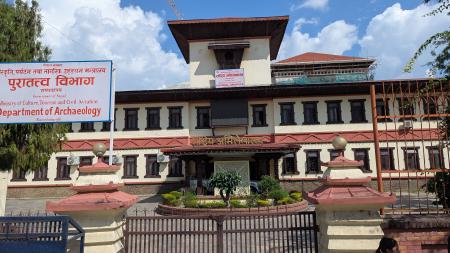
A few Bhatbhateni stores were saved by none other than the local people around the store. I met Hari Chaudhari of Labipur, Sunsari who shared with us how he and his friends sensed the incoming mob and carefully and strategically deterred them from vandalizing the Bhatbhateni store in Itahari. Even within the troubled Singha Darbar, some responsible employees came forward to save their work places and important documents it housed. I am sure there are many like Hari who stepped in to resist the vandals but are not yet made into the ‘news’. Hrishav Raj Joshi & Sadichchha Shrestha wrote in Setopati – an online newspaper, about several accounts in which people saved artefacts and heritage while the mob destroyed some buildings housing important cultural artefacts and historical recordings. They also observed that even the mob seemed to be respecting things that are known as heritage, for example - the dismantled wheels of the Rato Matsyendranath chariot was untouched while a local ward office next to it was burnt down in Lalitpur. I got to know that the communities around the Patan Darbar Square were proactive to ensure that the mob would not get into the Darbar Square. Such proactive response from local communities was seen during the 2015 earthquake and the post earthquake reconstructions as well, for example – both the Kasthamandapa and Ranipokhari saw a strong opposition from local youths and activists when it became clear that reconstruction was planned to be done with less respect to the traditional building culture. Thanks to the local pressure, both Kasthmandapa and Rani pokhari have been restored much with the traditional system. I think such civic sense and behaviors are as important as our heritage culture as the heritage building themselves. So, among many other things, it is high time that we reflect on our culture, heritage and our behaviors. Today, I wish to touch upon the building housing the Department of Archaeology and (DoA) the National Archives (NA) (hereafter referred as DoA&NA) that was almost miraculously saved by a few aware citizens.
Journalist Sabina Shrestha reported on Setopati about how the DoA&NA was saved. As per this, a few artists led an impromptu campaign to deter the mob and save the DoA&NA building. Shrestha reported that a “young artist Jupiter Pradhan stepped forward to protect the Department of Archaeology from the protestors’ attack” and quoted his narrative:
“A group of people was trying to enter the Department of Archaeology. They had already broken the lock of the main gate. Seeing this, I thought I could convince them and stepped forward,” Pradhan recalled about Tuesday’s incident. “I explained to them what kinds of documents are kept in the Department of Archaeology, what archaeological records are, and how important they are.”
Jupiter Pradhan, as quoted in Setopati article by Sabina Shrestha
Further Shrestha reported:
“That day, Pradhan was preparing with some friends to stage a symbolic praotest by lying on sketches of 19 bodies. However, upon hearing that protestors were advancing toward Singha Durbar, he didn’t wait until evening for the demonstration. Along with his brother, he went out to the street and began creating some symbolic signs in front of the Department of Archaeology.”
From Setopati article by Sabina Shrestha
At the end of the story, the DoA&NA building was saved whereas the supreme court just next to the building, and the Health Ministry building (Louis I Kahn’s design) in front of it were unusably burnt and vandalized. I think this story of saving of the Department of Archaeology is worth reflecting upon, and hence I wish to draw my own inferences from this.
I wish to begin by discussing what I perceive as public perceptions prior to the protests. Singha Darbar was well known as the government complex, a palace complex that the Rana Prime Ministers had built for themselves, and an area not easily accessible to people in general. News media would often show the main entrance of Singha Darbar while reporting on some VIP or VVIP movements in and out of the Singha Darbar complex, and specific ministry building would be shown while reporting on specific ministry related or rather the particular minister related news. Largely this complex seemed totally disconnected from the general public, yet I assumed public would also appreciate the clerical importance of these buildings because they contained official documents for decades. Singha Darbar became the metaphor of the government, hence the entire complex perhaps was known to every Nepali as that ‘forbidden palace’ that ruled the country in whatever way one perceived. However, in general public parlance, it was just one of the ‘things’ in Kathmandu that anyone visiting the capital from outside ought to know or see if possible, along with Pashupatinath, Swayambhu, Dharahara, Rani Pokhari, Tundikhel and so on. Thus, it was a grand and historical building but it could never project itself as a heritage that really mattered to people.
The DoA&NA building was not a popular attraction but some section of our society had noted and perhaps used its services. It houses both the Departments of Archaeology and the Archives. It is not as crowded with public because not much of everyday business mattered to the majority of public. Yet, some interested or concerned stakeholders would know about this building – rather the offices operating from there. Perhaps, residents of old cities in Kathmandu, Patan and Bhaktapur knew this building more than any other citizens of the country because their lives are entangled with the ‘protected monument zone’ status that DoA has conferred upon their neighbourhoods. However, I imagine their association might not always have been so positive with DoA but perhaps an obligatory one pertaining to the norms of the Ancient Monuments Protection Act or the World Heritage Management framework. Certainly few professional circles concerned with archaeology, archives and cultural matters would be familiar with this building. Yet, in the public interest, this building hosts two very important offices and their importance cannot be denied. The building next to it – the Supreme court would have been known to far more people than those who knew the Department of Archaeology building, perhaps as many as those who knew about the Singha Darbar for the functional reason. And the building housing the Ministry of Health, just in front of the Department of Archaeology building, is one of the most important buildings for architects, but not so much for others. Even within architects’ community, it is an information rather than any association or of any business.
Hence, the story of saving the Department of Archaeology is entirely driven by conscious citizens like Jupiter Pradhan, who felt a moral obligation and a constitutional duty of a citizen to protect it. His arguments and appeal to the vandals also used the heritage rhetoric, but he also used his sense to exert psychological or power pressure to the potential vandals by collaborating with the staff, police and calling upon more of his own network of fellow citizens. This is a touching, inspiring, and provoking effort that he and his colleagues resorted to on that troubled day, without being sure whether it would work. Luckily their strategy worked and they succeeded in achieving the goals of saving the building. A similar effort was under way at Singha Darbar main gate but perhaps a compelling narrative could not be created there. Let us look into the narrative used to request the mob to spare the Department of Archaeology:
Reportedly, activist Jupiter Pradhan said to the groups that came to vandalise the DoA&NA building:
“I’m not Gen Z; I’m from Generation X. But I want to hand over this heritage and the documents here to Gen Z and Generation Alpha that follows. If we preserve and pass it on to them, they too will protect it and pass it on to the generations after them.”
Jupiter Pradhan, as quoted in Setopati article by Sabina Shrestha
So, it seems the key words ‘heritage’, and the goal of passing it onto the next generation – not just Gen Z but also Gen Alpha, worked. This is where I wish to connect our earlier discussions of the term heritage – particularly the key argument of when something becomes heritage. As I write again and again, something becomes heritage when it matters to people and they collectively declare as such. At the situation portrayed above, somehow the message was conveyed that the Department of Archaeology was a ‘heritage’ that mattered to all generations, and it seemed to be agreed by the group of protesters who intended to burn it. Similar narrative for Singha Darbar did not seem to work perhaps because people may have a range of reservations with what happened in Singha Darbar. The health ministry building was not in any one’s radar despite the fact that it was designed by one of the masters of modern architecture.
On the basis of above, I wish to reiterate the argument that something is heritage only when it matters to people. Hence we (the heritage professionals) need to explore what connects to people, why, and how we can nurture such connections – by documenting, appreciating, preserving, conserving, managing well and so on. This argument or the conception of heritage as a discourse where ‘people’ are at the core is not new – see some of my own writings as well as those of Gamini Wijesuriya and others. However, what is more important is to put this discourse into practice and policies. This is where my intention of this blog lies.
I wish to call upon the Department of Archaeology of the Government of Nepal as well as other related Ministry and agencies to learn insights from the recent incidents, and pledge to pursue heritage policies in Nepal, not for the sake of conservation but for serving people while also connecting to them and empowering them through the discourse and frameworks of heritage. Heritage is a powerful and useful concept as long as we deeply understand it and work with it. It can bring us all on the same page and motivate to work for a shared cause. On the other hand, heritage can also be a point of conflict and a completely disconnected movement if it is pursued just for the sake of it.
On this basis, I wish to suggest that the DoA&NA building can now be declared as a heritage building although it is not in the list of protected monuments or declared heritage. Technically, it has not crossed the 100 years mark as per the Ancient Monuments Preservation Act. 9 September 2025 brought in a different perspective and realization to this building. We are lucky that people have saved it against all the risks on that day. An awareness has arisen out of fear, but also driven by a civic sense. This is important and need to be enshrined as our heritage ethics. Therefore, to mark the public interest in the DoA&NA and their commitment, to remind us to reciprocate such a bold act, I wish to suggest that DoA&NA building is declared as a heritage building now. However, the suggested declaration as heritage is not in a monumental sense, but in the sense of a public appreciation. Therefore, this heritage declaration is in the spirit of memorializing the recent GenZ protest and the timely issues it has raised. It is also in recognition, promotion and institutionalizing the much needed civic sense displayed by a few citizens with regards to the DoA&NA building. Thus, the heritage here is not just the physical building but the culture of appreciating and protecting a building for what it does for the public and the nation as a whole. It is a much deeper notion of heritage than the prevalent historic and materialistic notion.
If a majority of us agree on my proposition of this recognition of heritage for DoA&NA building, it should charge the Department of Archaeology with a fresh responsibility of maintaining this heritage spirit. Again, the heritage reference here is not just for the building as a physical fabric but the public protection that it received and the civic responsibility that very gesture represented. The identity of Nepali public should be known for that resilience and persistence than those of destroying many others. Thus, such a recognition is not merely to celebrate the spirit, but to encourage every one of us to imbibe such a civic responsibility in our everyday life. How can the Department of Archaeology ensure that such a legacy is continued?
First, the department needs to acknowledge officially and appreciate publicly people’s protection it received on 9 September 2025. Second, it needs to revisit some fundamental guiding principles of our heritage policies which are primarily similar to the John Marshal’s laws in British India (I wonder if we inherited such colonial policies although we were never colonized, or it was just a coincidence that our act seems similar to colonial heritage ideals). Critically speaking, our heritage policies need to acknowledge people and encourage their ownership in heritage matters as much as possible. Hence, in the light of the above, it is high time for the DoA to reciprocate to the public by revisiting our heritage policies and institutionalizing public discourse of heritage in a collaborative framework. This should help nurture public interest and proactive engagement in identifying and preserving our heritage. In doing so, it should also broaden the scope of heritage to various aspects of culture including what is today internationally called as ‘intangible cultural heritage’ and integrate it into the DoA discourse of heritage (which has primarily been an archaeological and physical/material discourse of heritage). Arriving to a heritage discourse that contextualizes the ethos of Nepali society through its tangible, intangible as well as natural and cultural legacies to both the historic and the contemporary achievements and aspirations would be a logical outcome of the recent movements led by the young generation. However, this may need an inter-departmental and inter-ministerial collaboration as well, and I think the DoA is well positioned to lead it.
I will be happy to elaborate on my conclusion should there be further interest from the Department of Archaeology and related agencies and professionals. I hope this opinion piece will be taken in a constructive spirit and wish to hear your thoughts on this brief reflection.
3 October 2025
neelkamal.chapagain@ku.edu.np